
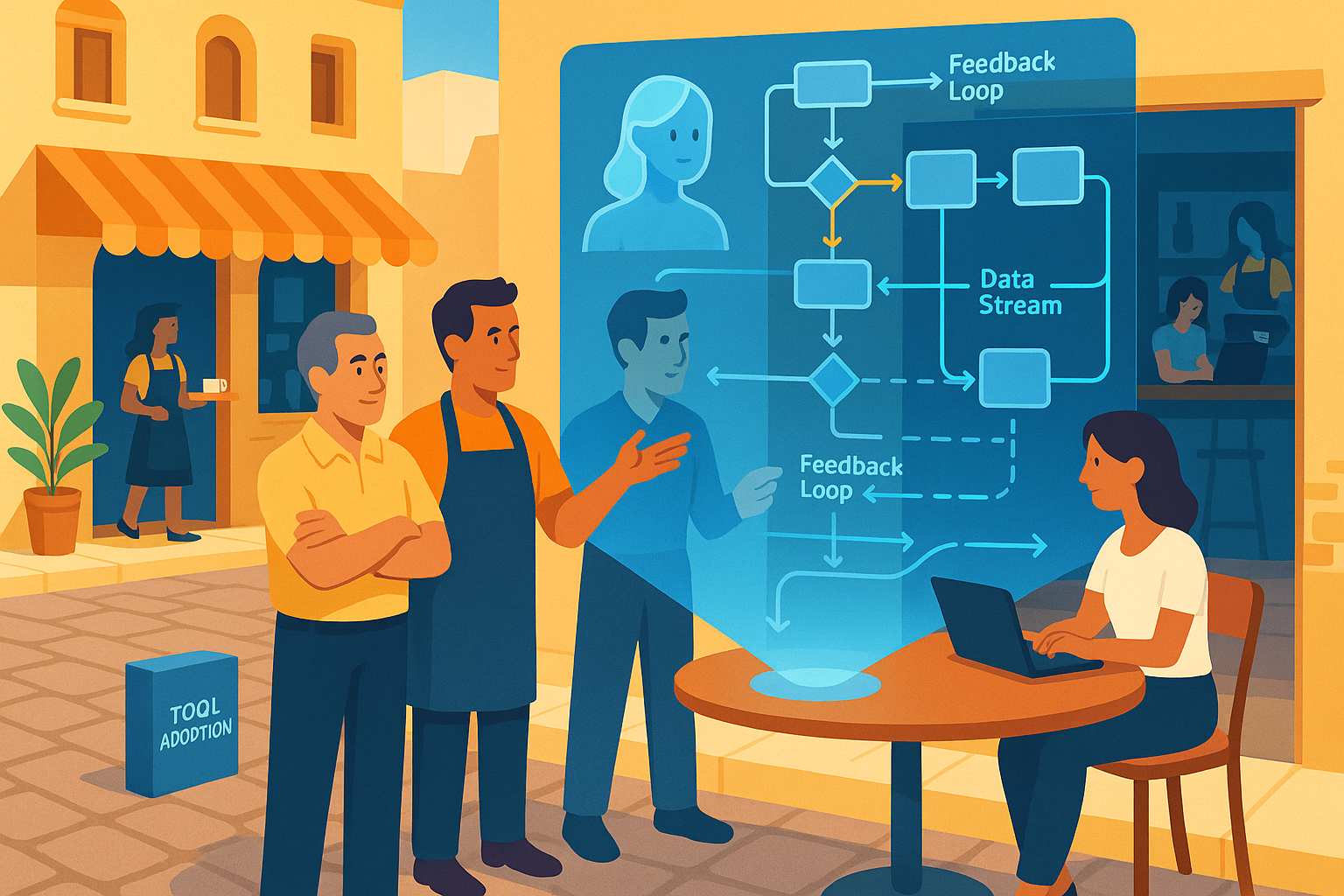
Why adoption isn’t the same as advantage — and how organizations must redesign work, not just buy tools
Distinguishing AI Adoption from Achieving Organizational Success with AI
At a high level, “using AI” means putting AI tools into an organization and encouraging people to adopt them; “succeeding with AI” means changing how work gets done so human-AI collaboration is the default way value is created. That distinction matters because the same technology can deliver dramatically different outcomes depending on whether it’s treated as an optional add-on or as the core capability around which processes are rethought. Two headline facts make the point starkly. Across many studies, only about 22% of companies that have adopted AI report meaningful bottom-line impact. In contrast, organizations that intentionally redesign workflows around AI report success rates approaching 78%. That gap isn’t about access to algorithms, it’s about organizational design. The implication for leaders is simple but uncomfortable: buying or licensing AI is insufficient. The strategic question shifts from “Which tool do we buy?” to “How does the work need to change so AI and people together produce the outcome we want?” That reorientation changes priorities, budgets, metrics, and the leadership conversation about risk and opportunity.
Cyprus’s Microenterprise Structure Creates Unique AI Transformation Risks
Cyprus presents a unique combination of structural vulnerabilities and opportunity. Roughly 93% of registered businesses are micro-enterprises (firms with fewer than 10 employees). These businesses are the backbone of the economy, but they typically lack in-house expertise, have limited spare capacity to run cross-functional redesign projects, and have processes that evolved over decades of manual work. When micro-businesses adopt AI with the traditional “install-and-train” mindset, several failure patterns commonly appear: a strategy vacuum where AI is used because others are doing it rather than to solve a clear bottleneck; integration nightmares with legacy, spreadsheet-based processes; and pilot purgatory, where useful pilots never scale. There’s also the trust problem, employees may perceive AI as a headcount threat and resist, which kills production deployments. Put together, these realities mean a high rate of nominal adoption in Cyprus will likely deliver low impact unless organizational redesign is front and center. And because larger firms, both regionally and across Europe, are more able to redesign work at scale, the result is a widening competitive gap rather than convergence.
What Redesigning Work Around AI Looks Like in Practice
Think of redesigning work as changing the job’s architecture rather than changing the tools people happen to use. Concretely, several consistent patterns show up across successful redesigns:
- Start with the outcome and map the value stream end-to-end. Ask where decisions are made, what information is used, and where time or errors create the largest business drag. Only after mapping do you consider where AI can contribute.
- Make human-AI collaboration the default. That means the process is structured so the AI’s recommendation is the normal path, and human judgment is required primarily for exceptions. This flips the optionality problem: it’s not “do I use AI?” but “how do I act with the AI’s output?”
- Reallocate resources toward people and process design. High performers often invert conventional budgets: instead of spending most on algorithms and technology, they spend the majority on redesigning roles, incentives, and feedback loops so the AI’s outputs continuously improve the process.
- Embed learning mechanisms. Whenever a human overrides or refines an AI recommendation, that interaction becomes the source of improvement. Over time the combined system learns faster than either humans or machines alone.
As a concrete contrast, imagine two retailers both buying the same demand-forecasting model. One keeps quarterly ordering meetings and treats AI as one input; the other redesigns ordering cadence, makes AI recommendations the default, and requires documented overrides. The outcomes diverge sharply even though the underlying model is identical.
Leadership and Cultural Shifts Needed for AI-Centered Work Design
The cultural shifts are substantial and intentional. Four stand out:
- Embrace continuous improvement: successful organizations treat processes as never finished. This requires normalizing experimentation and tolerating calculated failure as a learning mechanism.
- Transparent role redefinition: leaders must communicate honestly about which tasks AI will handle and how people will be redeployed into higher-value work. This reduces fear and builds buy-in.
- Data transparency and cross-functional collaboration: AI needs data flows, and data often lives in silos. Leadership must prioritize cross-silo sharing and metrics that reflect business outcomes rather than tool usage.
- Metrics and incentives aligned to outcomes: instead of tracking training completions, measure inventory carrying costs, time-to-serve customers, or margin per employee.
Trade-offs and risks are real. Redesign demands time, attention, and sometimes short-term productivity dips. If handled poorly, it can erode trust and provoke talent flight. Data quality or legacy-system frictions can slow progress. There’s also a governance risk: automating decisions without clarity about accountability can cause ethical or compliance problems. Leaders should therefore treat redesign as a strategic investment with governance guardrails: set clear outcome goals, accept short-term disruption, and measure the right things. The alternative is the quieter risk of gradual decline, investing in technology that never changes how value is created.
High-Impact Priorities for Resource-Constrained Small Businesses Implementing AI
For resource-constrained organizations, the strategy is to be selective and intentional — not to avoid AI, but to focus on a tiny set of high-impact changes. First, prioritize value stream mapping for one critical process: the job of transformation is to identify a single bottleneck where speed, cost, or quality would materially change business performance. This might be demand forecasting for a retailer, supplier responsiveness for a restaurant, or repetitive customer questions for a boutique service provider. Second, make redesign decisions that change the workflow’s default behavior rather than layering a new tool on top of an unchanged process. That means redesign choices — who sees the recommendation, when it becomes actionable, and how overrides are handled — should be decided before technology selection. Third, leverage networks: peer learning through industry associations, shared implementations, or government-sponsored programs can reduce the knowledge burden. The goal of these partnerships should be capability transfer, helping the business internalize continuous improvement practices, not just delivering a turnkey black box. Finally, be explicit about people outcomes: define how roles will change, what skills will be developed, and how employees benefit. When team members see personal upside — time for customer-facing work, new responsibilities, clearer career paths — resistance softens and success becomes more likely. All of these are strategic priorities rather than technical checklists. They focus scarce effort where it magnifies impact.
Key Takeaways for Cyprus Leaders Transforming Work with AI
Four compact takeaways:
- Understand: AI is not merely another software purchase. It’s a capability shift that can only reach its potential if the work itself is redesigned around human-AI collaboration.
- Reconsider: True ROI comes from transformation, not adoption metrics. If your planning stops at procurement and training completion, you’re likely to see limited business impact.
- See differently: Start with the value stream and one high-impact process. Make AI the default path in that process and embed learning loops so the system improves over time.
- Recognize: People matter. Address role change proactively, build trust through transparency, and create pathways for employees to move into higher-value work.
A forward-looking note: in markets like Cyprus, this is a narrow window to build structural advantage. The technology itself will be widely available; the durable edge will come from organizations that change how they operate around it. Leaders who treat AI as an organizational design question rather than a procurement question will be the ones who turn adoption into advantage.
Leave a Reply